The problem
A warranty claim is a customer telling you that something you sold them broke. On’s process made that a slow conversation. Claims waited on manual validation, support answered the same corrections over and over, and the case-to-order ratio climbed high enough to strain the team.
Where the time actually went
I mapped the existing journey end to end, looking for where claims stalled and where people abandoned them.
Most of the delay wasn’t the decision. It was the round trips. A claim would arrive missing something, support would write back asking for it, and the clock started again. The customer found out their claim was incomplete two days after they’d stopped thinking about it.
The fix
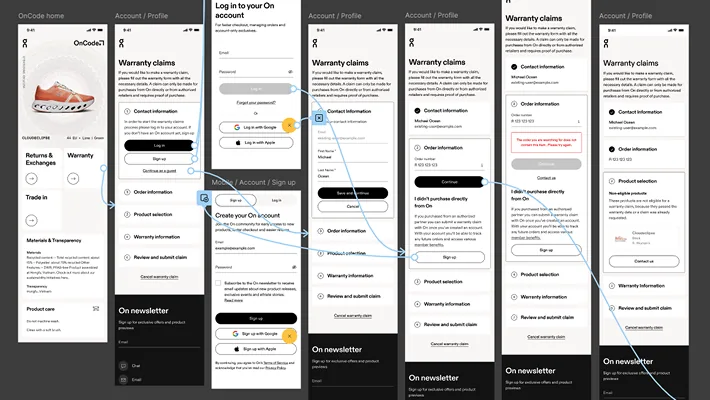
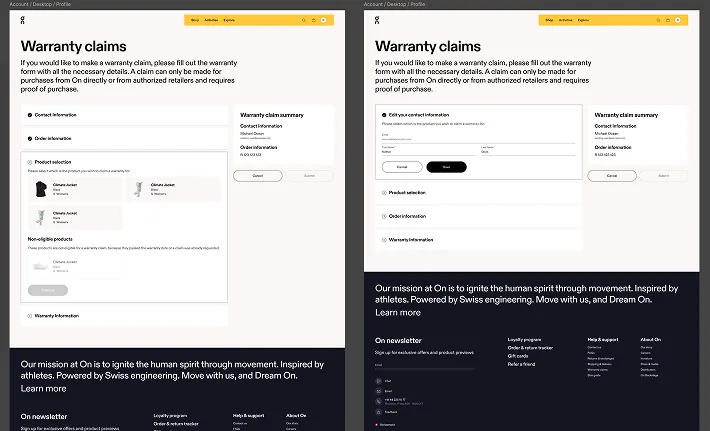
Move the checking upstream. I designed flows that validate claim data as it’s entered, so what reaches support is already complete. The customer learns what’s missing while they’re still looking at the form.
That removes work in both directions: fewer messages for support to send, fewer for the customer to answer.
Prototypes went in front of real users, and the flow changed several times based on what they did with it.
What changed
Processing became 2.3× faster, cutting the time on a claim to under half. The case-to-order ratio fell by 4.4×. Retention improved, because a claim resolved quickly is a customer who stays.
What I took from it
The win came from removing steps, not adding features. Every field that validates itself is a support conversation that never has to happen.